PVC vs Silicone for Keychains and Promotional Gifts: A Cost Comparison
Read:58
At the same volume, a soft PVC keychain is usually 20 to 40 percent cheaper per piece than a moulded silicone one, and the silicone version is the better product. Which one you should buy depends on what the item is for: a trade-show giveaway with a three-month life, or a retail accessory that has to survive a year in a pocket. The cost gap comes from four specific places, and only one of them is the material.
The short answer. Choose PVC for multi-colour 3D figures, tight budgets and short-life promotional runs. Choose silicone for anything that will be handled daily, exposed to sun or heat, marketed to children, or positioned as a premium retail item. If the design needs both rich colour and durability, a silicone body with a printed or domed face is the compromise most brands end up at.
Cost structure, side by side
| Cost element | Soft PVC | Silicone |
|---|---|---|
| Mould | Lower; often aluminium or copper cavity | Higher; steel or aluminium built for pressure and heat |
| Compound | Cheaper per kilo, widely available | More expensive, and food-grade grades carry a premium |
| Colour | Filled by hand into open moulds; sharp separation | Pre-mixed compound or pigment; fewer distinct colours per face |
| Cycle time | Short; PVC sets by heat in the mould | Longer; compression cure of several minutes per cycle |
| Tooling life | Shorter, softer cavities wear | Longer, steel tools run hundreds of thousands of cycles |
| Typical MOQ | From 300–500 pcs per design | From 500 pcs, higher with multiple colours |
| Hardware and assembly | Similar; chain and ring dominate | Similar; silicone often needs a moulded-in loop |
Why PVC is cheaper to produce
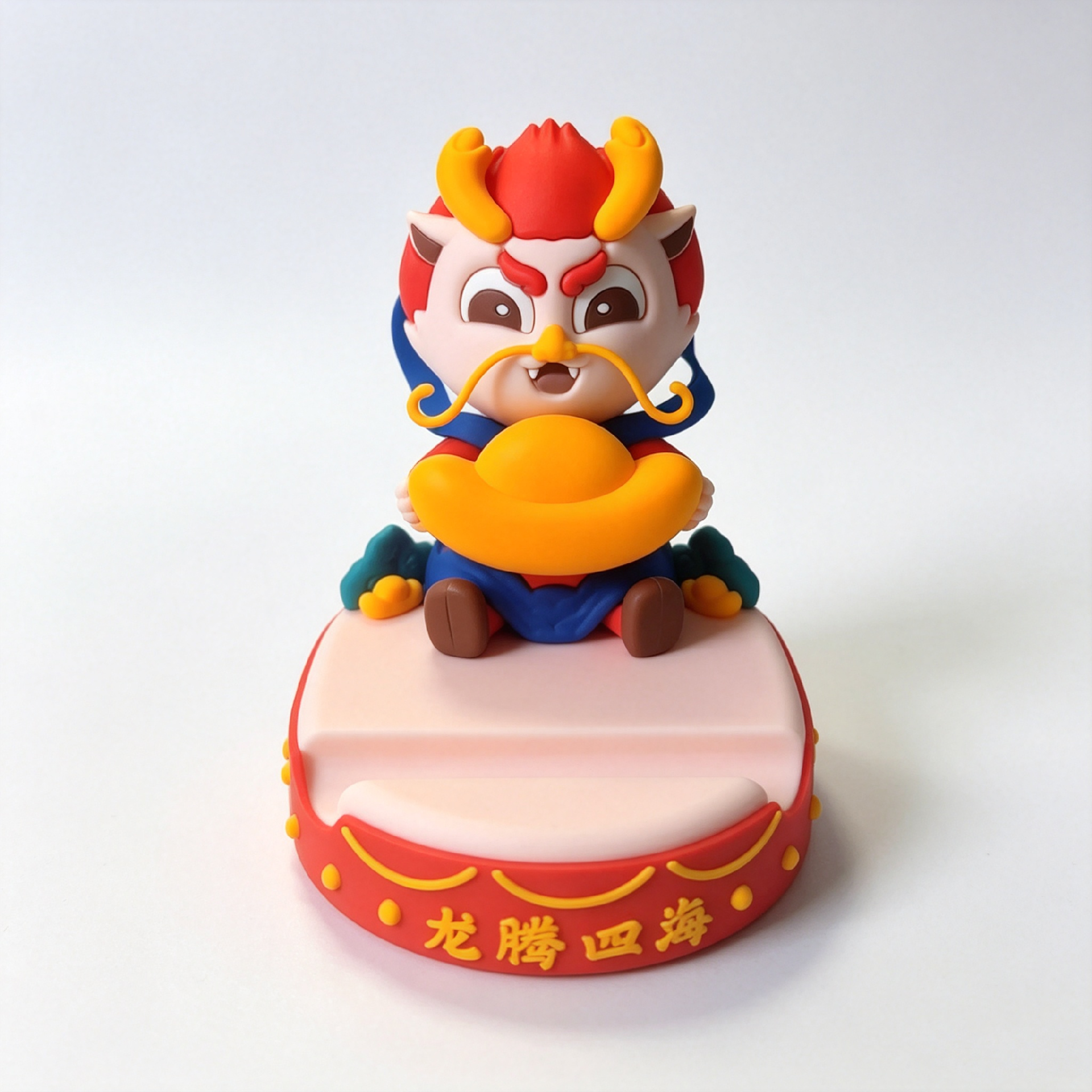
Soft PVC is processed at lower temperature and pressure, so the tooling is simpler and cheaper, and the mould can be filled by hand with a squeeze bottle. That open-mould colour filling is the key economic difference: a five-colour PVC figure can be built up colour by colour in a single cavity, which is exactly what makes the material so good at character merchandise. Silicone cannot be filled that way at production speed. Multiple colours mean separate compound batches, careful placement, and longer cycles.
PVC also tolerates a wider range of fillers and recycled content without obvious cosmetic penalty, which pushes the compound cost down further. That is an advantage on price and a disadvantage on feel.
Where silicone earns its premium
- No plasticiser migration. PVC needs plasticisers to be soft, and those are the source of the phthalate questions, the oily film on a car dashboard, and the sticky residue on an old keyring. Silicone has nothing to migrate.
- Heat and UV. A PVC charm left in a hot car can deform and leach. Silicone at 40 Shore A will come back to shape.
- Feel and perceived value. Silicone is dry, grippy and dense in the hand. Buyers read that as quality, which is why premium retail programmes gravitate to it.
- Tear and bite resistance. If a child may chew the item, silicone is the material with a workable compliance route and the mechanical behaviour to match.
- Colour stability in white and pastel. PVC tends to yellow as plasticiser migrates; silicone holds light colours far better over time.
Compliance: what each material triggers
PVC for gifts sits mainly under toy and general product safety rules if it is aimed at children: EN 71-3 for heavy metal migration, EN 71-1 and -2 for physical safety, and CPSIA in the US, including the 0.1 percent limit on restricted phthalates. Lead and cadmium in pigments are a recurring failure point on cheap PVC, which is why the pigment source matters as much as the compound.
Silicone avoids the plasticiser issue but is not automatically compliant. For child products it needs the same EN 71 and CPSIA route, and the filler quality matters: heavily filled compounds tear at the hardware hole, and some "-free" claims collapse under testing. For food-contact claims, the silicone must meet FDA 21 CFR 177.2600, LFGB 30/31 or GB 4806.11 — PVC cannot make that claim at all.
In both cases, test the hardware. Chains, split rings and clips are metal, and nickel release and lead content failures are more common on keychains than material failures.
Matching material to the programme
- Trade-show giveaway, 500–2,000 pcs. PVC, or a printed acrylic blank with a resin dome. Lowest cost per unit, and the item only needs to survive the event.
- Retail accessory with a two-year shelf life. Silicone. The unit cost difference is absorbed by the retail price, and returns from chipped or sticky product cost more than the material saving.
- Character or licensed figure with five or more colours. PVC. Colour filling is the only economic way to get that look at volume.
- Child-targeted item. Silicone, with tested hardware and full EN 71 or CPSIA documentation. Do not put a PVC charm on a nursery product.
- Premium gift or corporate set. Silicone body with a printed or domed face, or silicone combined with a metal plate. This is where the material premium is easiest to justify.
Total cost over the product life
Unit price is the smallest part of the comparison. Add the cost of the second order (PVC tools wear faster), the returns rate from deformation and stickiness, the freight difference (PVC is heavier per piece), and the cost of a compliance failure if the item is child-related. On a three-year programme, silicone frequently closes a 30 percent unit gap and sometimes beats it.
What silicone will not do is match PVC on colour complexity or on the very lowest promotional price. If those are the two deciding factors, buy PVC and specify a non-phthalate formulation with tested pigments.
FAQ
Can PVC be phthalate-free?
Yes, non-phthalate plasticisers are common, particularly for EU and US toy programmes. But the claim must be supported by a test on the specific formulation and colour, not by the compound supplier's general statement.
Does silicone yellow over time?
White and translucent grades can shift slightly under prolonged heat and UV. Opaque colours are stable. If a pure white is essential, specify a UV-stabilised grade and accept a small cost increase.
Which material takes a logo better?
For bold flat colours, PVC colour filling gives the crispest result. For fine detail and gradients, printing on silicone or a resin dome over print is better. Laser marking works on silicone but produces a tone-on-tone mark, not a colour.
Can I switch material after the mould is made?
No. The tooling, shrinkage and process are different, so a material change means a new mould and a new compliance file. Treat the decision as fixed once tooling starts.
Next step
Send the artwork, the target quantity and where the item will be sold, and we will quote both materials on the same specification so the comparison is honest. Our PVC and dropper glue range covers moulded and domed gift items, and the OEM and ODM service handles silicone programmes with tooling ownership and compliance documentation.