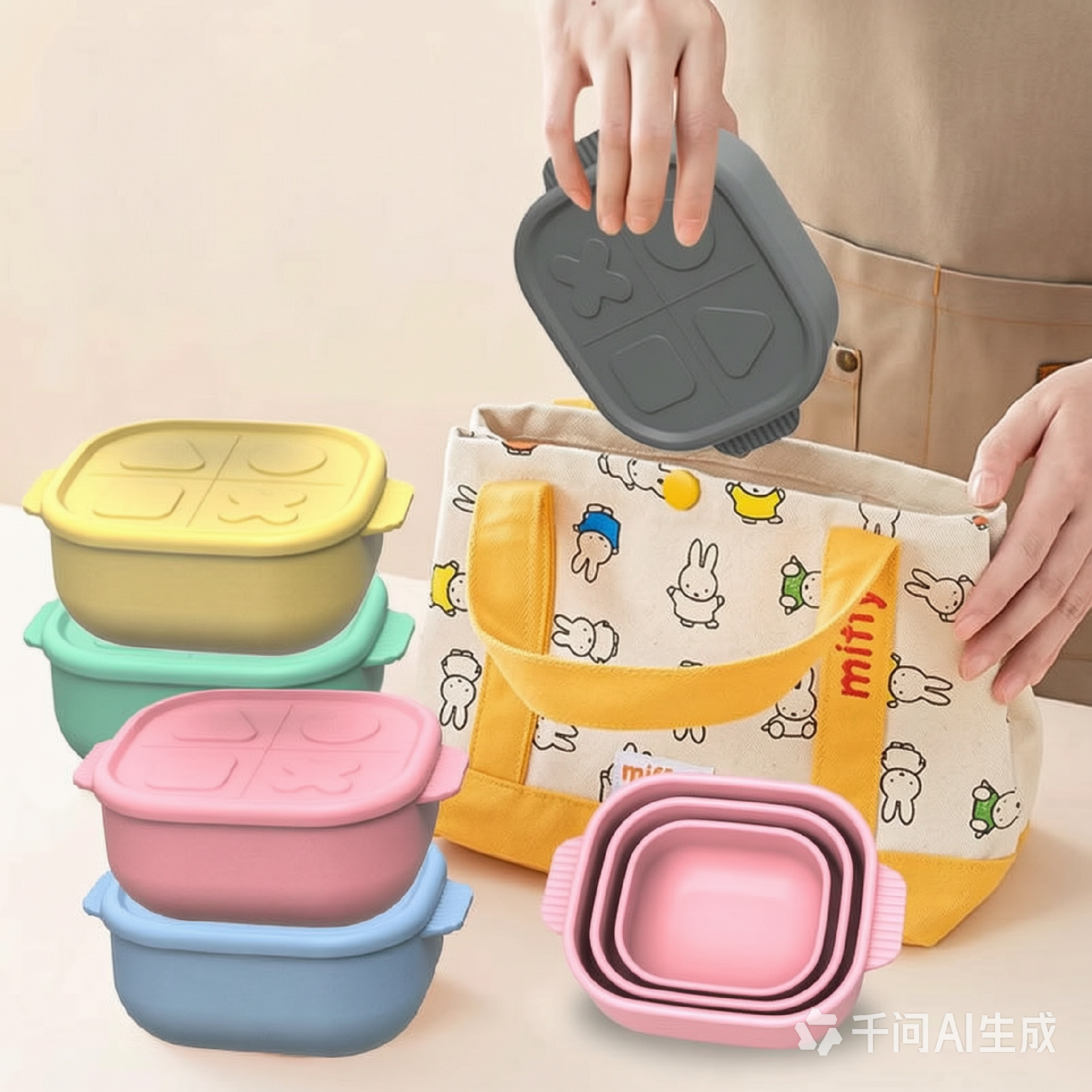
Silicone Snack Boxes for Toddlers: Sizing, Safety Features and Retail Specification
Read:7
Toddler snack boxes are a distinct category from adult lunch boxes: portions are smaller, hands are clumsier, and every latch, corner and divider is judged against safety-first retail standards. The buying conclusion is that portion sizing and one-handed latch operation drive the purchase, while small-parts safety and food-contact compliance decide whether the listing survives review. Specify both before you compare prices.
How the toddler category differs from adult lunch boxes
An adult bento box optimises capacity and leak security for commuting. A toddler snack box optimises access and portion control: the child should open it independently, the compartments should separate foods that "must not touch" according to every toddler ever, and the whole unit must survive being thrown from a high chair — repeatedly. That changes the specification: softer latch forces, rounded corners, shallow compartments a small hand can reach into, and a lid a two-year-old can close but not trap fingers in. Retail buyers who reuse adult designs at smaller scale end up with returns driven by frustrated parents.
Portion sizes and compartment logic
Successful toddler snack ranges converge on a compact size ladder that parents combine into a day's eating:
| Format | Typical capacity | Primary use | Design notes |
|---|---|---|---|
| Small snack pod | 150–250 ml | One snack, stroller bag | Single cavity, soft latch, no small parts |
| Two-compartment box | 400–600 ml | Dry snack plus fruit | Divider must clear the lid seal line |
| Three to four compartments | 600–800 ml | Daycare lunch format | Check each cavity reachable by small hands |
| Pod set with tray | 4 × 150 ml | Snack drawer organisation | Lids interchangeable across pods |
Resist the temptation to maximise capacity. Toddler portions are small by design, and parents read oversized boxes as wasteful. Depth matters more than footprint: a shallow cavity lets a child see and reach everything, which reduces mealtime refusal.
Small-parts and mechanical safety
Any component that could detach is the first thing auditors and reviewers check. Specify moulded-in latches rather than hinged plastic clips with separate pins, avoid removable gasket rings in toddler SKUs, and pull-test every feature so nothing produces a small part under force. Vent plugs, common on adult boxes, are generally excluded from toddler designs for exactly this reason. Ask the factory to run the applicable small-parts and torque/tension tests for your target market and to document the results — for the US market, CPSIA testing and tracking-label requirements apply to children's products, and European programmes work to EN-migration requirements for food-contact materials. Confirm the exact scope with your testing lab rather than relying on category claims.
Latches, lids and one-handed reality
A toddler latch needs a paradoxical specification: light enough for a two-year-old to open, secure enough not to pop open in a bag. The workable solutions are a flexible silicone tab-latch with a wide press zone, or a quarter-turn lid with a shallow cam. Have the factory show you the opening force measurement, then test with the actual target age group if you can. Avoid magnetic latches in children's products — small strong magnets are a regulated hazard if the latch ever separates.
Material and colour programme
Platinum-cured silicone meeting FDA 21 CFR 177.2600 (US) or LFGB-based requirements (EU) is the standard choice, and the certificate must cover the coloured compounds — nursery ranges lean on pastel palettes, which platinum curing renders cleanly. Two-tone bodies and coloured lids add a second moulding or a carefully managed multi-cavity colour change; price both options before committing, because the cost difference is usually modest at volume but noticeable at small runs.
Cost, tooling and MOQ
Tooling for a toddler snack box is comparable to a small bento programme: typical sample lead time of two to three weeks and mass production roughly three to five weeks after approval, with MOQs commonly starting around 1,000–2,000 pieces per colourway. Unit cost drivers are silicone weight, cavity count and the latch design; printing (character-free, brand-safe artwork) adds little when done by silkscreen or deboss. Treat these as planning ranges to confirm in writing, not fixed commitments.
What to put in the RFQ
- Target age range and the portion sizes the range must cover.
- Compartment layout, maximum depth and hand-reach requirement.
- Market and compliance scope: CPSIA, EU food-contact migration, small-parts testing.
- Latch type with opening-force target; confirm no magnets or loose inserts.
- Colourways and whether lids are shared across pod sizes.
- Packaging: try-me window, hanging tab or shelf box.
FAQ
Are silicone snack boxes safe for toddlers?
When built from food-contact-grade silicone with moulded-in latches and no detachable small parts, the material and construction are well suited to toddler products. Require compound certificates for the coloured grades and small-parts plus mechanical test reports for the finished product, scoped to your market.
Can toddler snack boxes go in the dishwasher and microwave?
Platinum-cured silicone bodies tolerate dishwasher sanitation and microwave reheating. Verify the latch geometry does not trap food or deform in the dishwasher basket, and state "lid off or vented" for microwave use in your instructions where heat build-up is possible.
Do they actually stop leaks?
For dry snacks and cut fruit, a well-seated silicone lid is sufficient. Soupy foods demand a moulded-in gasket and even latch pressure; many toddler SKUs deliberately skip liquid-tight claims to keep opening forces child-friendly. Match the claim to the design rather than promising both.
What MOQ is typical for a custom toddler range?
Industry-typical MOQs run 1,000–2,000 pieces per colourway on a new tool, with lower quantities possible on standard bodies with logo-only customisation. Confirm tool ownership terms early if you plan to extend the range across seasons.
Next step
Send your portion targets, latch requirements and market compliance scope for a manufacturability review, or browse reference items under silicone baby products and the wider product catalogue. Our custom OEM and ODM service covers tooling, colour matching and compliance documentation in-house.