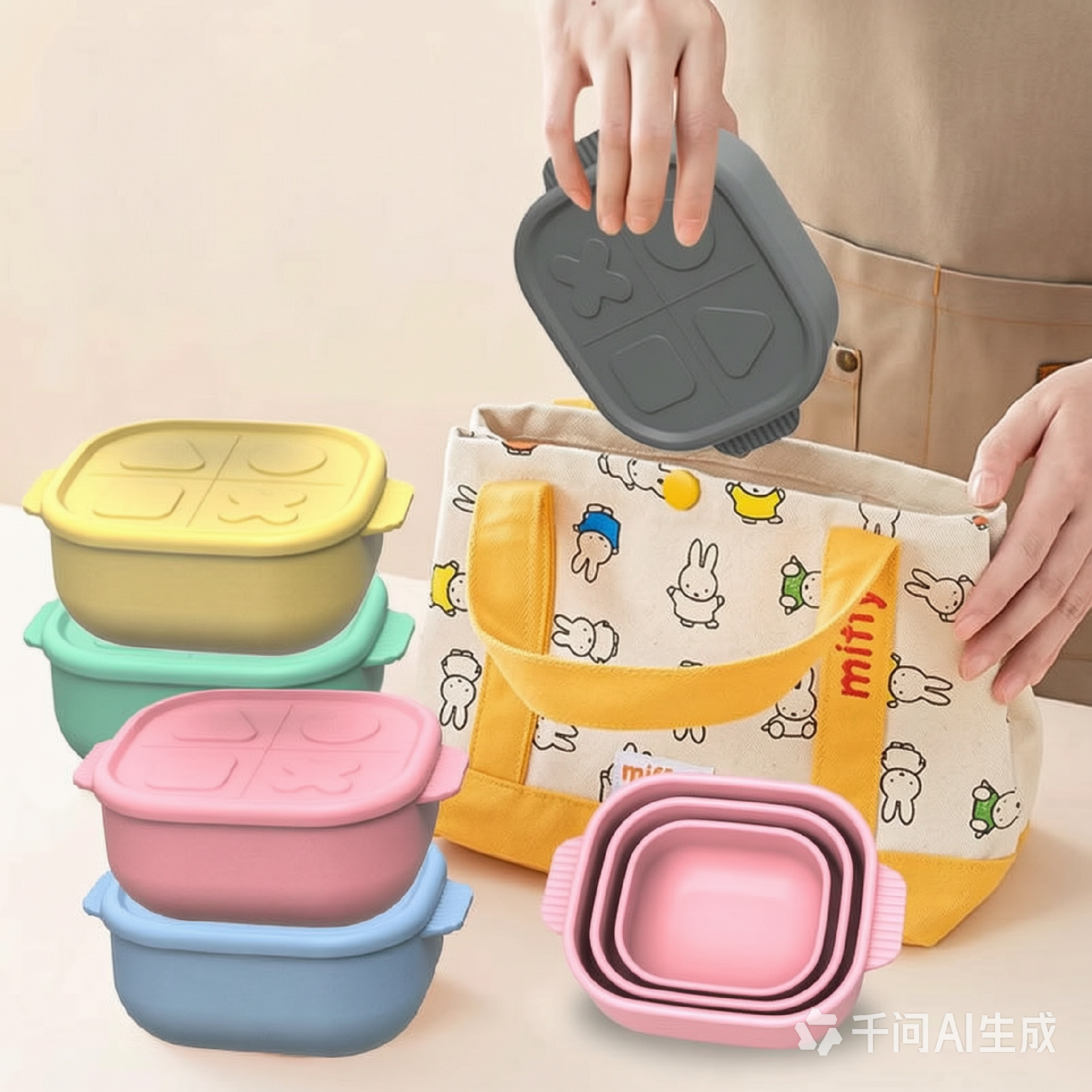
Silicone Lunch Boxes for Schools and Offices: A Buyer's Guide to Compartments, Seals and Compliance
Read:11
Silicone lunch boxes win in three areas where plastic boxes disappoint: they fold or collapse for the commute, they tolerate microwaves and dishwashers without warping, and they stay flexible at freezer temperatures instead of becoming brittle. The buying conclusion is straightforward: the lid and seal system, not the base, is where lunch boxes succeed or fail. Evaluate the closure first, then the compartments, then the silicone grade — in that order.
Why silicone has entered the lunch box category
Polypropylene lunch boxes are cheap and rigid, but they stain with tomato-based foods, absorb odours, crack when dropped at freezer temperature, and cannot go from freezer to microwave safely in one piece. Silicone addresses each of those pain points: it is naturally stain-resistant, odour-neutral, flexible to about −40 °C, and stable to well above boiling water temperature. For office lunch programmes the folding feature matters most — a collapsed box occupies half the bag space of a rigid one — while for school programmes the safety story (no sharp corners, no shattering) and the dishwasher durability carry the purchase decision.
There is a cost reality to accept up front: a silicone lunch box carries a higher unit price than a comparable PP box. The retail proposition therefore has to be built on durability and reusability, which is exactly why the silicone grade and the seal must be specified properly rather than left to the factory's cheapest default.
Compartments, capacity and everyday portioning
Compartment layout is the specification buyers most often get wrong. Three patterns dominate the market, and each suits a different eater:
| Layout | Typical capacity | Best for | Watch-outs |
|---|---|---|---|
| Single open cavity | 600–900 ml | Adult office lunches, mixed meals | Foods mix; needs dividers or separate cups |
| Two fixed compartments | 700–1,000 ml | School programmes; main plus side | Divider height must clear the lid seal |
| Three or more compartments | 900–1,200 ml | Meal-prep retail; family sets | More cavities, more moulding complexity, higher reject risk |
Fixed dividers are moulded as part of the base and cost little extra in a compression or injection tool. Removable dividers add assembly steps and another part number, which most programmes do not need. Confirm divider height against your intended foods — a divider that sits below the gasket line lets sauces migrate between compartments the moment the box tilts.
The seal: what leak-proof actually means
"Leak-proof" is the most contested claim in this category. A lunch box that survives an upside-down test with water can still leak soup through the corner of a clipped lid, because the four corners are where flat gaskets lose pressure. The robust designs share two features: a continuous silicone gasket moulded into the lid (not an inserted ring), and latching clips that pull the lid down evenly on all four sides rather than pinching it at two points. Vented lids — a small silicone plug that opens for microwave steaming — add convenience but create one more leak path, so the plug must have its own captive seal.
When you receive samples, test them the way users will: fill with soupy food, lay the box on its side in a bag for an hour, then invert. Ask the factory for the test method they use to substantiate the leak claim and put that method into your purchase specification. A supplier who can describe their leak test precisely is usually a supplier who manufactures the gasket in-house.
Material grade and food-contact compliance
Because the box touches food hot and cold, the compound should meet FDA 21 CFR 177.2600 for the US market or LFGB-based requirements for Europe, and the certificate must cover the coloured compound, not just natural silicone. Platinum-cured silicone is the standard choice here: it leaves less volatile residue, has better transparency for pastel colours, and survives repeated dishwasher cycles without turning tacky. A peroxide-cured compound can pass migration tests but tends to bloom a white residue early in the product's life, which triggers retail returns even when the migration numbers are legal.
Temperature and honest use claims
Silicone handles freezer storage, reheating and dishwasher sanitation in a single product life, which is the core of the packaging story. Keep claims within tested bounds: a compound rated for continuous exposure at roughly 200–230 °C covers microwaving and hot-fill use with margin. Straight-sided boxes with thick bases heat unevenly in a microwave — specify a base thickness that warms through in two to three minutes for a standard meal, or users will conclude the box is "slow". Collapsible walls thin the base, so collapsed-state microwave use should be tested, not assumed.
Cost drivers and order structure
Unit cost is driven by silicone weight (a collapsible box uses less material than a rigid one of the same capacity), the number of cavities in the tool, and the complexity of the lid-gasket assembly. Colour adds little in a well-run factory because pigment is mixed at compounding, though two-tone bodies need a second moulding step. Industry-typical practice for a custom lunch box programme is a new tool plus samples in two to three weeks and mass production roughly three to five weeks after approval, depending on volume — treat these as ranges, not promises, and confirm both stages in writing.
MOQs for a custom-moulded lunch box generally start around 1,000–2,000 pieces per colourway so tooling amortises sensibly. Tool ownership or guaranteed-reuse terms are worth negotiating before the first deposit, especially if you plan seasonal colourways on the same body.
What to put in the RFQ
- Capacity and compartment layout, with the foods the box must survive (soup, curries, pasta).
- Target market and food-contact requirement so the compound is chosen once, correctly.
- Collapsed and expanded dimensions if the design folds, plus the collapsed-state thickness.
- Lid construction: moulded-in gasket vs inserted ring, clip count, and vent plug requirement.
- Colour references per component, including lid, gasket and clips.
- Logo process: debossed, printed or laser-marked, with artwork files attached.
- Test requirements: leak method, dishwasher cycle count, freezer-to-microwave transition.
FAQ
Are silicone lunch boxes really leak-proof?
Boxes with a moulded-in continuous gasket and four latching clips pass realistic leak tests including side-lying and inversion. Designs that rely on a loose gasket ring or two-point clips will leak at the corners with soupy foods. Specify the leak test method in your purchase order rather than trusting the word "leak-proof".
Can they go from freezer to microwave?
Yes — silicone stays flexible at freezer temperatures and is stable at microwave reheating temperatures, unlike PP, which becomes brittle when frozen. Remove metal clips or any stainless cutlery inserts first, and loosen the vent plug or lid corner to avoid pressure build-up.
Do silicone lunch boxes absorb smells?
Filled-platinum-cured silicone is far more odour-resistant than PP or TPE. Persistent curry or garlic odours usually indicate heavy mineral filler or a peroxide-cured compound; ask for the compound specification and ageing data, not just a fresh sample.
What MOQ should I expect?
For a custom mould or custom colourway, industry-typical MOQs run 1,000–2,000 pieces per colour; standard-tool bodies with only logo customisation can start lower. Negotiate tool ownership and reuse terms before paying tooling.
Next step
Send artwork, capacity targets and your leak-test requirements for a manufacturability review and quotation, or browse reference items under silicone kitchen products and the wider product catalogue. Our custom OEM and ODM service covers tooling, colour matching and compliance documentation under one roof.