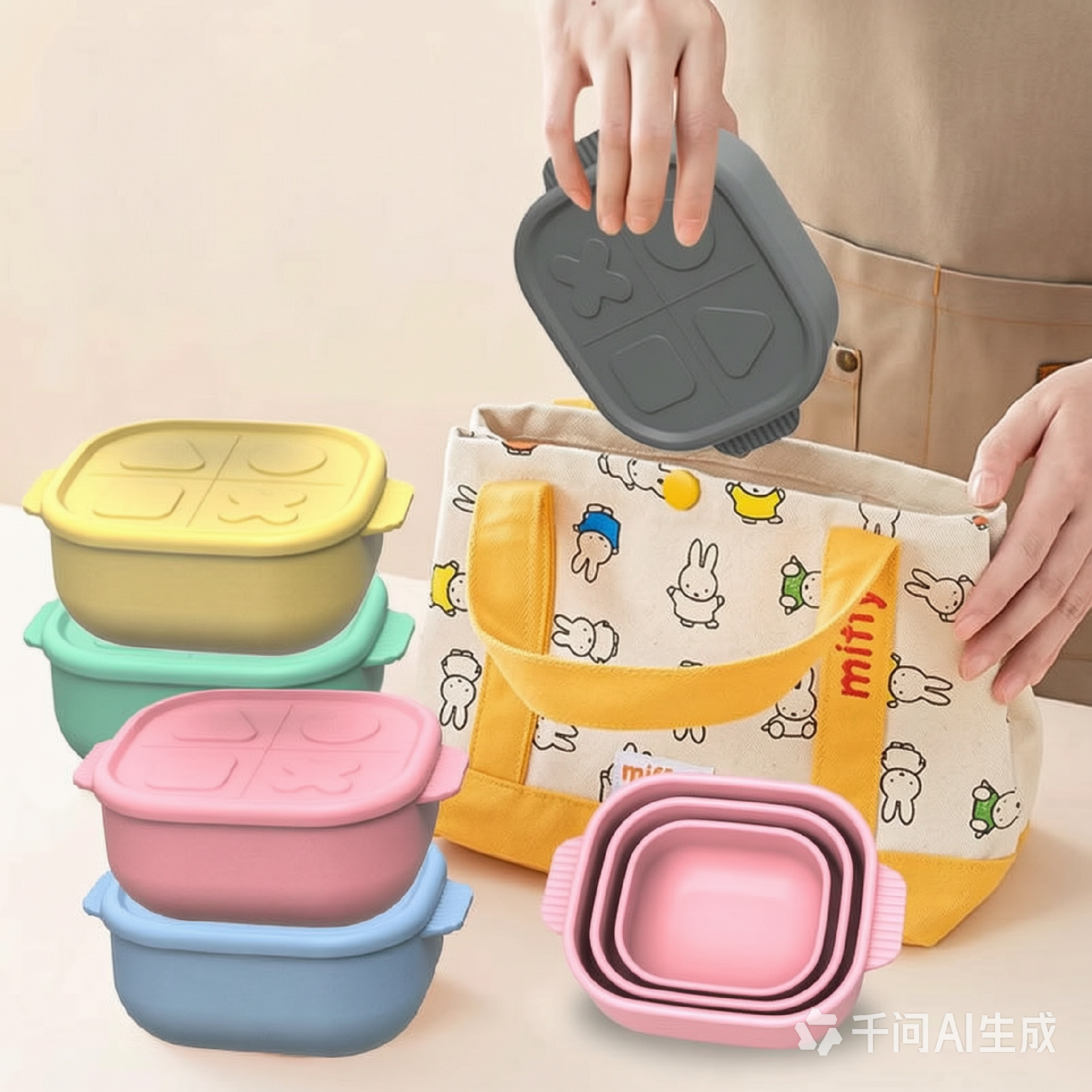
Silicone Collapsible Products: Where Folding Designs Fail and How to Specify Durability
Read:10
Collapsible silicone products — folding bottles, collapsing cups, roll-up pet bowls — win shelf space and lose customers in the same place: the fold. Buyer returns overwhelmingly trace to four failure modes at the folding zone, and all four are predictable from design and specification decisions made before tooling. Specify the fold deliberately and a collapsible product survives thousands of cycles; treat it as a styling detail and it fails in weeks.
The four failure modes
| Failure | Where it appears | Root cause |
|---|---|---|
| Tear at the crease | Hinge zone after 50–300 cycles | Radius too small; local wall too thin; hardness too high |
| Leak at the collapsed seal | Cap-to-body interface when folded or squeezed | Seal face area insufficient; cap tolerance mismatched |
| Set deformation | Bottle will not return to full shape | Wall stiffness low; fold stored for months under load |
| Whitening / crazing | Outer crease surface after repeated folding | Over-cured or over-stretched surface; pigment incompatibility |
Whitening deserves a note: it is not dirt but micro-creasing of the surface. It does not leak, but it reads as "worn out" to a consumer, so for premium programmes it is a genuine acceptance criterion.
Design decisions that determine fold life
The hinge zone is the whole game. Three parameters interact:
- Fold radius. A sharp internal crease concentrates strain. Generous radii at the fold line — a few tenths of a millimetre of tooling steel, essentially free — multiply cycle life. When a factory proposes a crisper fold "for the look", ask for the strain calculation or the cycle test to back it.
- Local wall thickness. The hinge should be slightly thinner than the body so it folds first and folds easiest — but only slightly. Too thin tears; too thick makes the body buckle instead of the hinge.
- Hardness. Collapsible bodies typically run 40–55 Shore A: soft enough to fold by hand, firm enough to stand upright when open. Below 40 the product stands poorly; above 55 folding force becomes a complaint.
Sealing when collapsed
A folding bottle leaks in the folded state even when it is watertight open, because collapse changes the geometry of the cap seal. The specifications that matter: a seal face wide enough to remain engaged through the full fold range, a cap closure with positive mechanical engagement rather than friction alone, and a defined mating tolerance between cap thread and body. For travel bottles specifically, require the factory to demonstrate the folded-and-shaken leak test — filled, folded, inverted and shaken — not just an upright fill test. See our silicone travel bottles page for the product context.
The cycle test to specify
Replace "durable" with a number. A reasonable acceptance test for a folding bottle or cup:
- Cycle count: 2,000 fold-unfold cycles by fixture or trained operator, at room temperature.
- Interval checks: leak test every 500 cycles (filled, folded, inverted, 10 minutes).
- Visual gate: no tear, no crack initiation at the hinge; whitening beyond a defined reference panel is a reject for premium grades.
- End-state function: after 2,000 cycles the product must still stand open, seal closed and pass the final leak test.
- Stored-fold check: one unit kept folded for 30 days must recover to full shape within one hour of unfolding — this catches set-deformation formulations.
Material and process notes
Platinum-cured compounds are the default for collapsible drinkware: the folding zone works hard, and peroxide by-products concentrate fatigue at high-strain areas while raising odour risk near the mouth. Pigment choice matters at the hinge — heavy loads of some inorganic pigments stiffen the compound locally, so colour-matched hinges should be validated with the cycle test in production colour. Post-cure completeness also matters: under-cured hinge zones craze earlier. For pet bowls and outdoor collapsing items the same physics applies with rougher handling, so we run the same cycle spec at a higher force.
FAQ
How many fold cycles should a good collapsible bottle achieve?
Well-designed hinges reach 2,000+ cycles without tear and pass end-state function. Consumer perception of "durable daily use" sits around 1–2 folds per day over two years — roughly 1,000 cycles — so 2,000 gives real margin.
Can the crease be reinforced with fabric or a plastic ring?
Yes, external stiffening rings and even hybrid designs are common, but each adds a second material, an assembly step and a compatibility question. For most programmes, a correctly radiused mono-material hinge is cheaper and removes an entire compliance surface.
Why does my bottle smell after months folded?
A trapped-moisture plus under-cure combination, usually. Insist on the sealed-jar odour test and a stored-fold unit check at sampling; both reproduce the complaint faster than waiting for customer reviews.
Does dishwasher use change fold life?
Repeated 70 °C cycles slightly accelerate whitening at the hinge. If dishwasher compatibility is a claim, add 20 dishwasher cycles into the middle of the 2,000-cycle test rather than testing them separately.
Next step
Send your collapsible design or reference sample and we will review the hinge geometry, propose hardness and wall spec, and quote tooling with the cycle test included. Our OEM and ODM service page shows the full development path, and the travel bottle range illustrates proven fold designs.