LSR vs HTV vs RTV Silicone: Which Process Fits Your Part?
Read:61
LSR, HTV and RTV are not grades of the same material — they are three different manufacturing routes, each with its own tooling, cycle time and design limits. Specifying the wrong one at the drawing stage is expensive, because the fix usually means a new mould.
The three routes in one table
| LSR (liquid silicone rubber) | HTV (high-temperature vulcanising) | RTV (room-temperature vulcanising) | |
|---|---|---|---|
| Form | Two-part liquid, pumped | Two-part semi-solid gum | Two-part liquid, poured |
| Moulding | Injection, metered and mixed | Compression or transfer | Cast into open moulds |
| Tooling cost | Highest — precision steel | Moderate — steel or aluminium | Low — silicone or resin mould |
| Cycle time | Seconds to a minute | Several minutes | Hours |
| Typical volume | 10,000+ pcs | 500–50,000 pcs | 1–500 pcs |
| Best for | Precision, thin walls, high volume | General parts, thick sections, cost-sensitive | Prototypes, large castings, low volume |
When LSR is the only sensible choice
- Wall thickness under 1 mm. HTV simply will not fill a thin section consistently; LSR flows under pressure and does.
- Tight tolerance. LSR holds ±0.05 mm on critical features far more reliably than compression moulding, because the cavity is filled under controlled pressure rather than squeezed.
- Optical and light-guide parts. Light transmission and clarity require the purity and consistency of a closed pumping system, with no operator handling of uncured material.
- High volume with automation. Once the tooling is paid, LSR cycle times make the unit cost the lowest of the three by a wide margin.
When HTV wins
- Thick sections. A 10 mm block cures more evenly in compression than in a thin-gate injection cavity.
- Short runs of a large part. LSR tooling for a 300 mm part is a serious investment; HTV tooling is not.
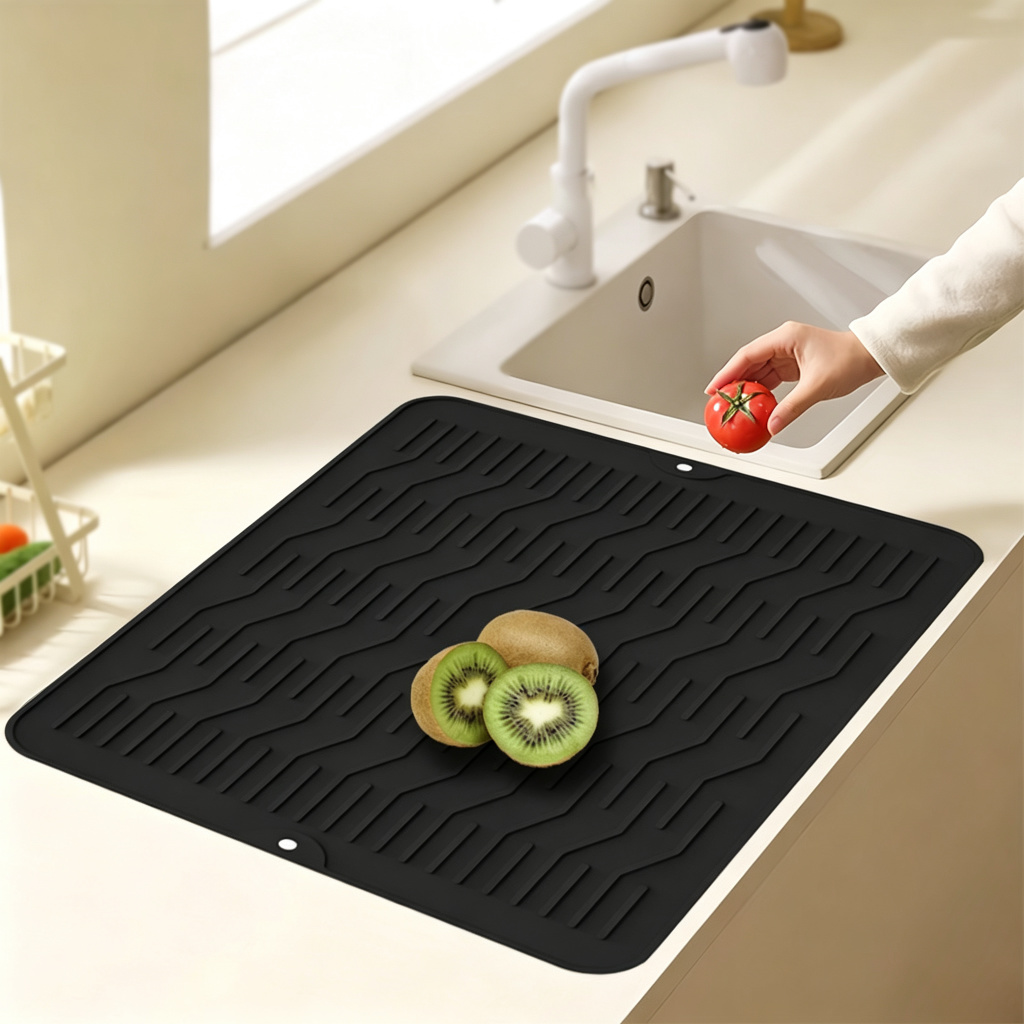
- Simple geometry, cost pressure. For a straightforward 40 Shore A mat or pad, HTV is usually the cheapest credible route.
When RTV is the right answer
RTV is the prototyping and short-run tool. It is also the only practical route for very large castings (a silicone block, an oversized gasket) where building a steel mould would never pay back. It is not a production process for consumer goods at volume, and a supplier proposing RTV for a 20,000-piece order is either misunderstanding the brief or planning to hand-cast, which means tolerance and cosmetic consistency will suffer.
Design rules that apply to all three
- Uniform wall thickness. Variations over 2:1 cause sink and cure differences regardless of process.
- Draft. Add 1–2° on vertical walls; soft material forgives less than people assume.
- No sharp internal corners. Radius them; sharp corners concentrate stress and tear on demould.
- Undercuts need a plan. Either a split mould, a collapsible core, or enough softness to strip — decide which before tooling.
- Post-cure. Specify it. It controls volatile content, smell and final hardness, and skipping it is the cheapest corner a factory can cut.
How the choice shows up in the quotation
Ask for the quotation to state the process. A quote without a process is not comparable, because the tooling line and the unit price move in opposite directions: LSR has the highest tooling and lowest unit cost; RTV has the lowest tooling and highest unit cost. At 1,000 pieces for a small part, HTV is usually the crossover point, and the difference between the best and worst route is often 30 to 50 percent of total spend.
FAQ
Can the same mould be used for LSR and HTV?
No. The mould structures are fundamentally different — LSR tools are built for pressure injection with tight shut-offs, HTV tools for compression. Converting is not economic.
Which process gives the best surface finish?
LSR, because the cavity surface is reproduced directly under pressure with no air entrapment. HTV can match it on a well-maintained tool but is more sensitive to operator technique.
Is LSR more expensive per part?
At low volume, yes — the tooling dominates. Above roughly 10,000 pieces for a small part, LSR is usually the cheapest per unit because cycle time drops from minutes to seconds.
Next step
Send the drawing with wall thickness and annual volume, and we will tell you which process the geometry actually supports — and what it costs at your volume rather than at a hypothetical one. See the OEM and ODM process or browse silicone 3C accessories for LSR examples.